Focus
Sébastien Cheramy — French Abstract Painter: The Wall That Watches
Sébastien Cheramy — French abstract painter bridging street culture and the gallery, from bold expressionism to the weathered, quiet beauty of wabi-sabi.

Sébastien Cheramy's canvases are not painted. They are built. Layer after layer, scrape after scrape, his surfaces accumulate the physical record of time. What emerges is not an image — it is an archaeology of gesture. A wall that has witnessed something.
“"I am inspired by the walls I see on the streets — spaces for contemplation, meditation, opening toward other things."
Cheramy does not paint walls. He makes them. The distinction is everything. A painted wall is a surface that has been covered. A wall that has lived is a surface that has accumulated — scratches, damp spots, cracks, the slow work of weather and time. His canvases belong to the second category. They look as though they have existed for decades, exposed to elements, bearing the physical record of duration.
The Early Work: The Sublime Chaos of an Abstract Painter in Motion
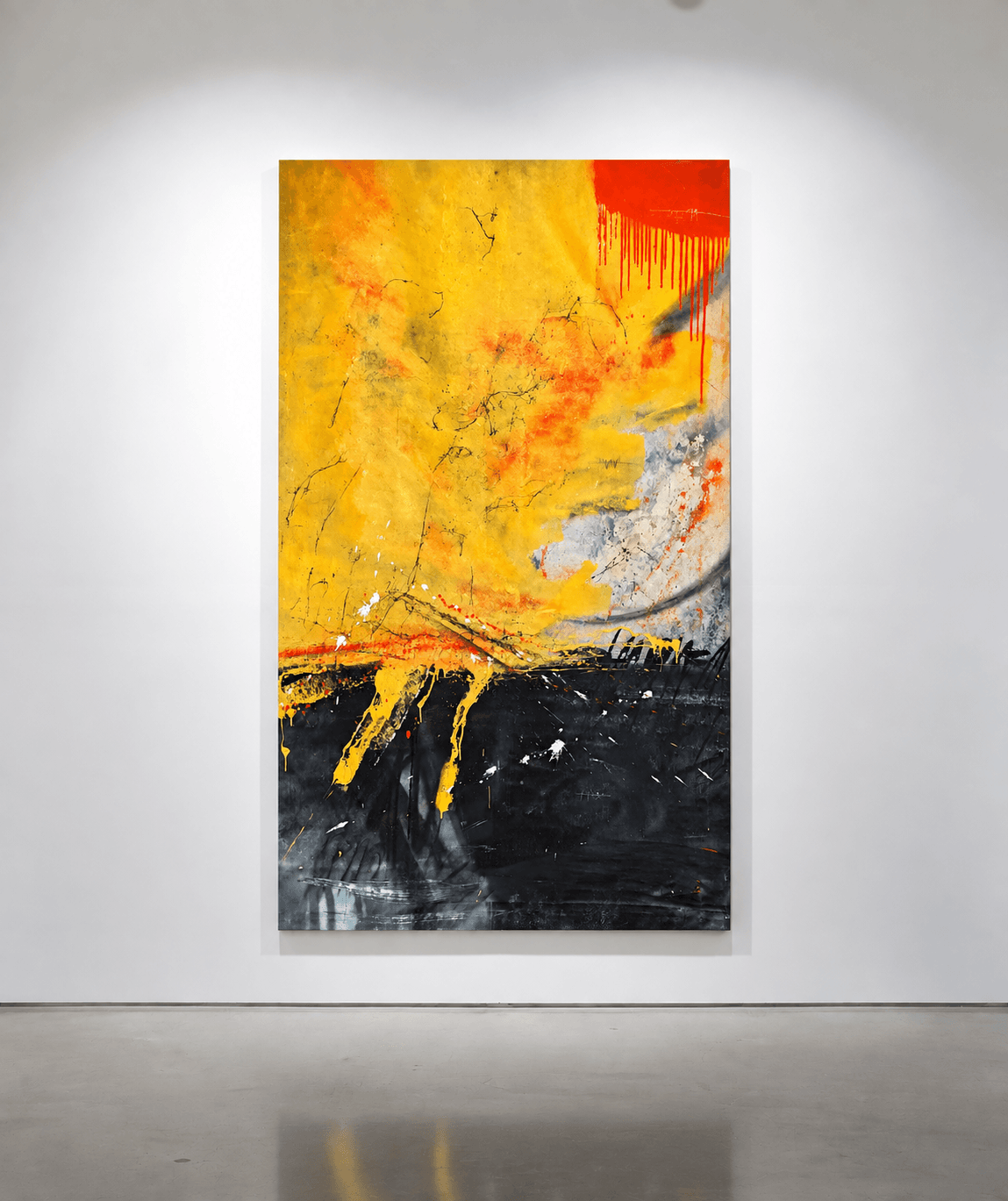
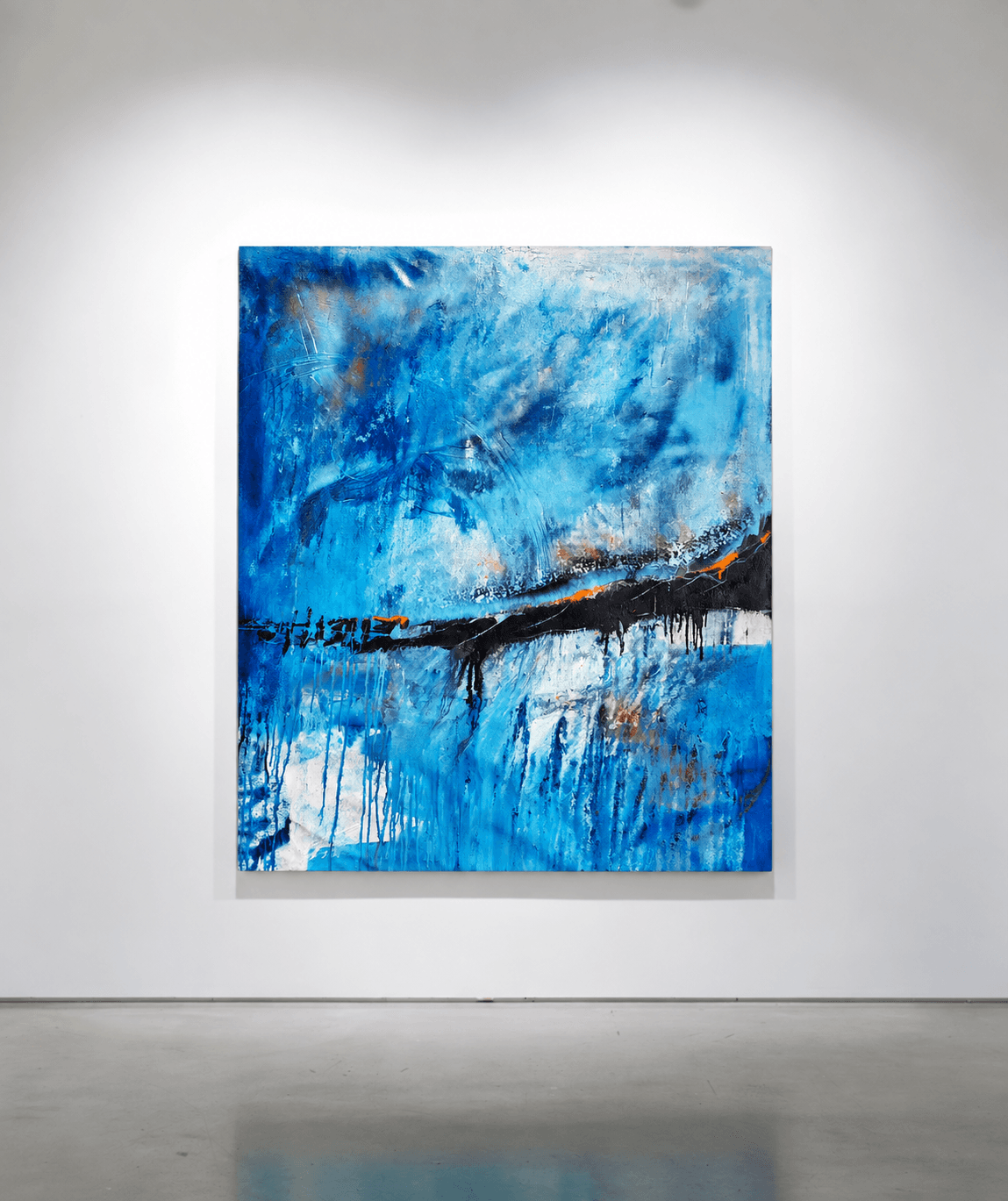
His earlier work was different. Bold strokes, explosive colour, a palette that alternated between deep blues and ferocious crimsons. The compositions were energetic, almost restless — what you might call sublime chaos. The brushwork recalled the way vines sprawl across an abandoned building: organic, uncontrollable, alive.
Yet even in this early phase, there was more than energy. Each piece resonated with a kind of organic growth, a paradox of deliberate and spontaneous strokes that suffused the work with raw vitality. His blues were deep seas of thought. His crimson shades bled with ferocity. The juxtaposition of cool and warm tones mirrored an exploration of conflict and harmony — a reflection on the dualities we navigate daily.
The calligraphic impulse was already there. Trained in both calligraphy and graffiti, Cheramy brought a mark-maker's sensitivity to abstraction from the beginning. Each stroke carried the weight of writing — a language approached but never quite decoded. Even in his most exuberant early pieces, there was intention beneath the spontaneity.
Before the colour came the absence of it. Cheramy's Landscape series — a body of monochrome works in greys, blacks, and whites — stripped abstraction to its bones. These were not landscapes in any geographical sense. They were psychological terrains: stark, dramatic, built on contrast rather than hue. The absence of colour was not a lack but a focus. In a world saturated with stimulation, his choice to work in greyscale was a deliberate pause — a reminder of the potency found in restraint. Looking at them now, you can feel the artist preparing himself for the shift that was coming, practising the discipline that wabi-sabi would later demand.
The graffiti training appears in other ways. Cheramy works with spray, brush, and drip — techniques inherited from street culture but used here with calligraphic precision. The spray gives him speed and atmosphere; the brush gives him control; the drip gives him accident. Each mark carries a different velocity, and the canvas registers them all. This layering of techniques is not a stylistic flourish. It is a direct inheritance from the street, where speed and intention must coexist.
The Wabi-Sabi Turn: When Abstract Painting Becomes Philosophy
Then, in 2023, something quieted.
Cheramy's shift toward wabi-sabi was not a rejection of his earlier self but a deepening. The Japanese aesthetic that finds beauty in imperfection, impermanence, and the authentic nature of reality gave him permission to slow down. The vibrant chaos of his earlier palette gave way to subdued earth tones. The dense compositions opened into breathable surfaces. The energetic gesture became the patient mark.
This transition is visible across his earlier monochrome Landscape series — greys, blacks, whites creating stark psychological terrains that prefigured the restraint to come. Those works were not so much about landscape as about internal states: dramatic contrasts of light and shadow mapping the contours of emotion. In revisiting them, you can see the artist preparing himself for the shift that was coming.
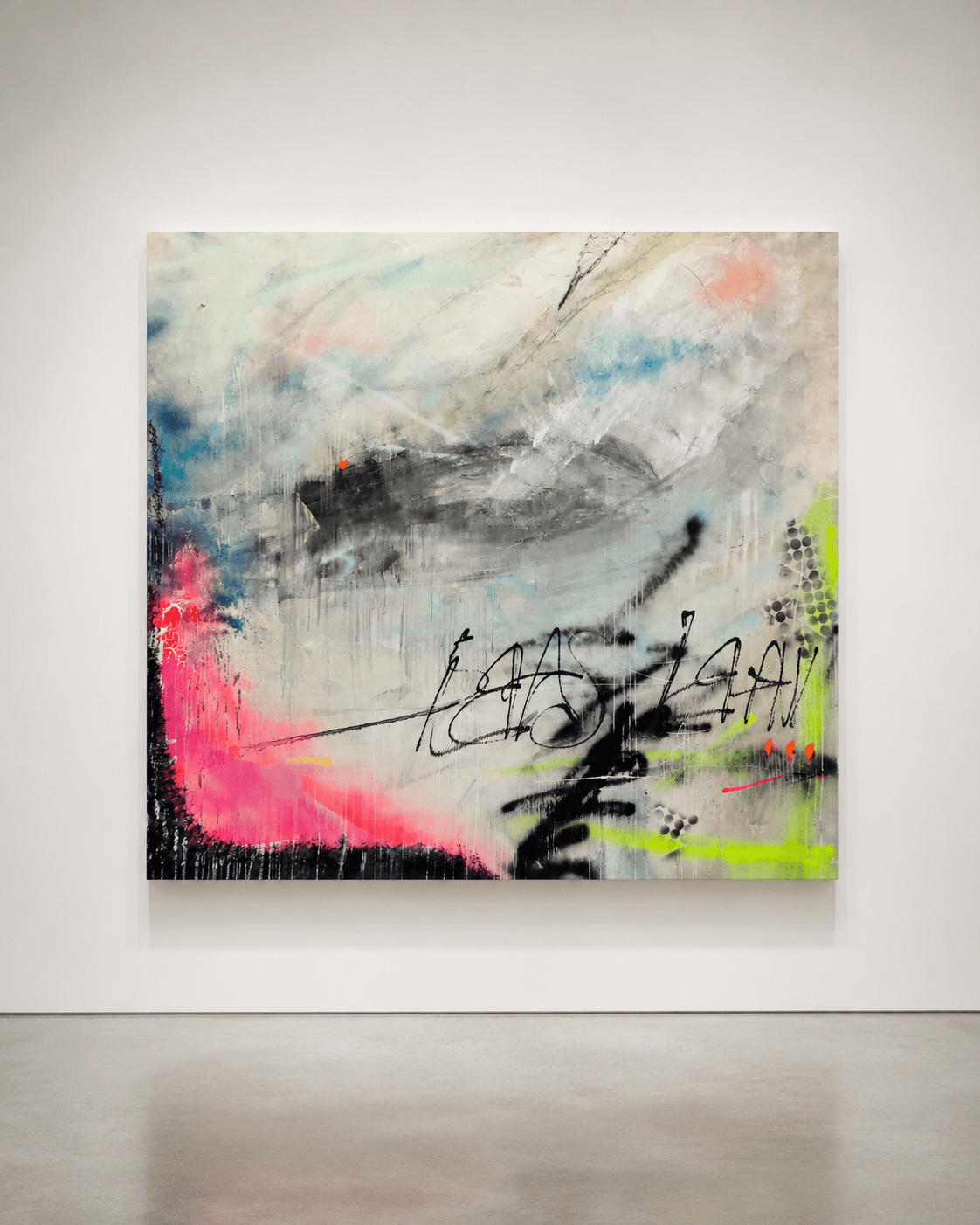
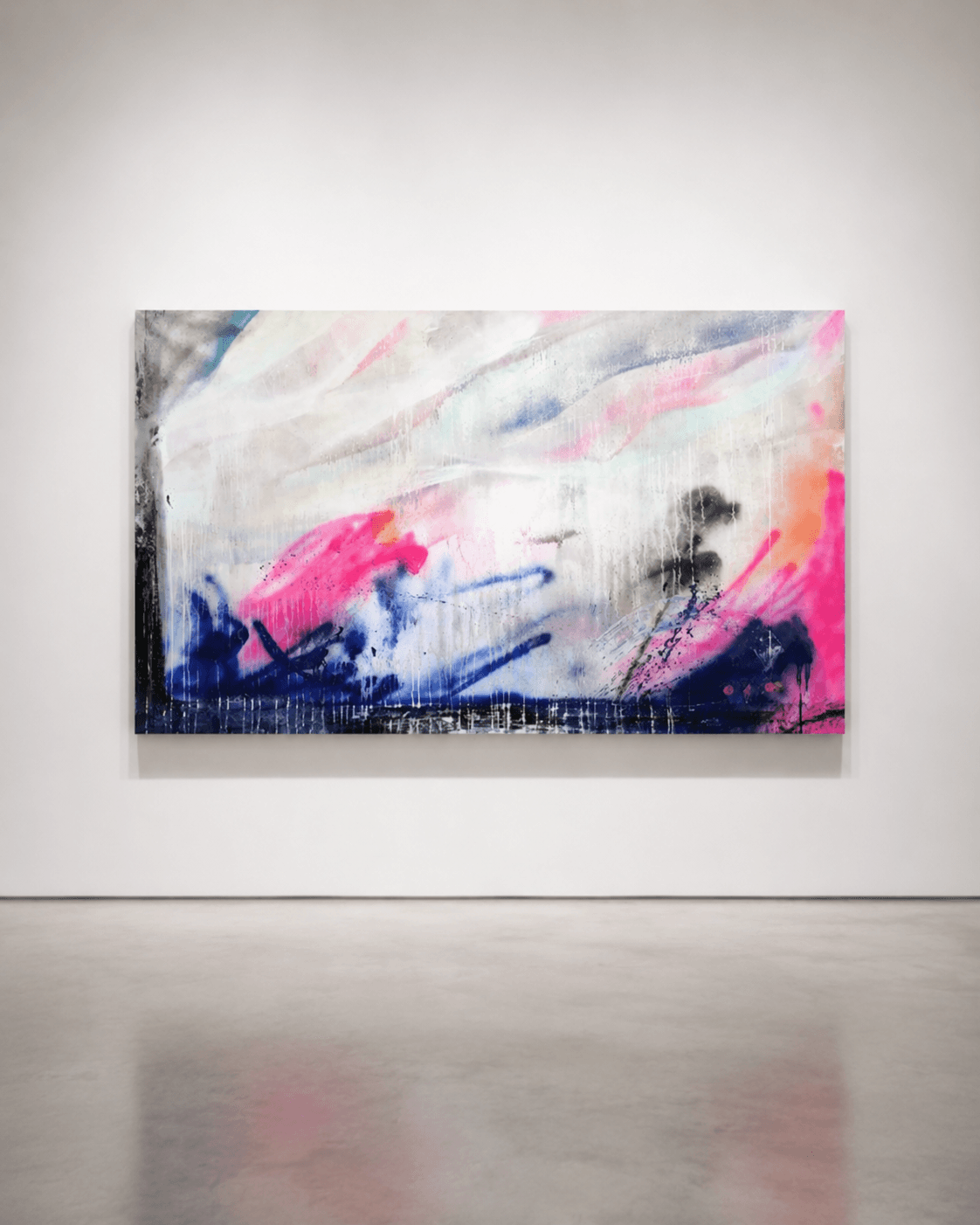
The Wabi Sabi series, produced across 2023, is the chronological record of an artist in dialogue with a philosophy. Each canvas is dated — WABI SABI 23092023, WABI SABI 10072023, WABI SABI 05102023 — as if each one were a diary entry in material form. The dates are not titles. They are timestamps of emergence.
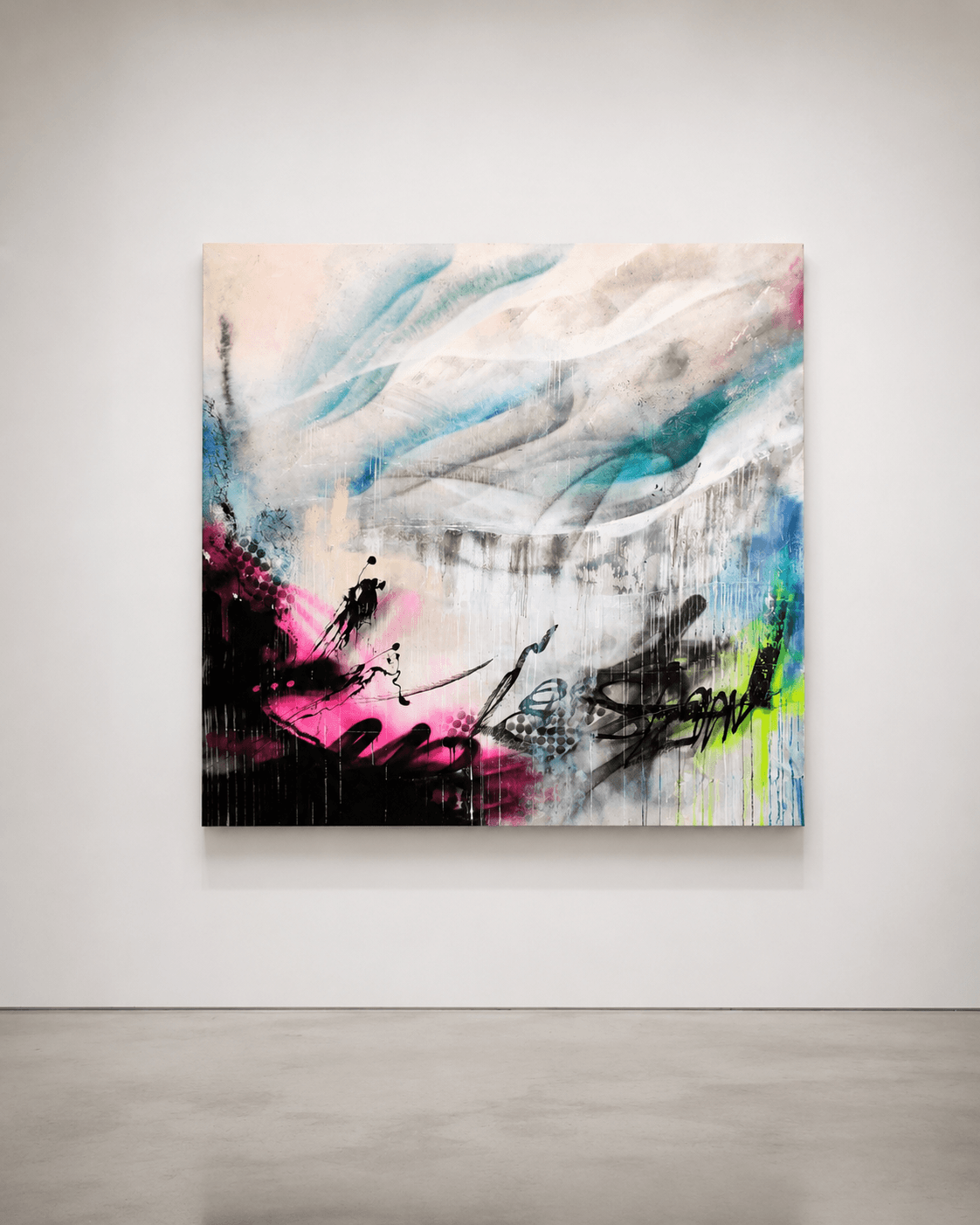
WABI SABI 23092023 operates on a sustained contradiction. The upper field exhales — pale blues, drifting whites, a quiet that reads almost meteorological. Then the lower register erupts: hot pink, deep charcoal, acid yellow, marks that refuse to stay still. The two halves should not cohere, yet they do.
WABI SABI 10072023 is the most panoramic of the series. The format is emphatically wide (200 × 120 cm), inviting a reading that is almost landscape. A deep navy anchors the base; a luminous white atmosphere floats above. Between them, electric pink gestures sweep across the surface like something half-remembered. The pink does not land. It sweeps, arcs, disperses. Impermanence not as subject matter, but as formal strategy.
WABI SABI 05102023 operates in the quietest register. Earth tones dominate: ochres, off-whites, greys. The surface is dense but not aggressive — layers scraped back, overpainted, marked by restrained calligraphic strokes. The painting looks as though it has existed for decades. You could be looking at a fragment of a Roman wall, or a piece of wood weathered by a century of rain.

The Canvas as Archive: Material Is the Message
“"The matter itself is very symbolic. It has sufficient characteristics to express and feel things."
He means this literally. The cracked surfaces, the bleeding colours, the places where the underlayer shows through — these are not decorative effects. They are the content of the work itself. The painting is not about something. It is something: a surface that has lived, a wall that has watched time pass.
Cheramy's practice has always explored the contrast and balance between life and death — a quiet current running through his entire body of work. He works slowly, allowing layers of material to become a language. The canvas becomes a historical document, each layer a testament to a moment passed. The peeling layers, the crackled paint, the drips and splatters — they tell a story of creation through decay, a narrative of time made visible.
What Stays With You
Stand in front of WABI SABI 05102023. The first impression is of age — a surface that has been there longer than you have. Then the marks emerge: a dark gesture here, a scrape there, the faint trace of something that was painted over. The painting does not reveal itself all at once. It unfolds, like a wall you pass every day and notice something new each time.
This is the quiet power of Cheramy's work. It does not demand attention. It waits. And if you stay with it long enough, it begins to feel less like something you are looking at and more like something you are inside — a room, a memory, a wall that has been watching all along.
If you are new to abstract art, start with our guide to what is contemporary abstract art. Born in 1979 and based in France, Sébastien Cheramy developed his abstract language over decades, drawing from street culture, calligraphy, and a deep engagement with materiality. His work is represented by galleries around the world, with a growing base of international collectors drawn to the rare combination of conceptual depth and physical presence that his canvases offer.
FAQs
Who is Sébastien Cheramy?+
What is his artistic style?+
What influences his work?+
Where to view and purchase his works?+
Related artist
Sébastien Cheramy→