Focus
Ludovic Dervillez — French Abstract Painter: The Mark That Hesitates
Ludovic Dervillez — French abstract painter transforming gesture and erasure into a space of pure inscription. A contemporary voice in refined abstraction.

What if a painting refused to be an image? In the work of Ludovic Dervillez, French abstract painter, the canvas does not represent — it inscribes, crosses out, hesitates, begins again. Every gesture is a decision. Every silence, a breath.
There is a moment, standing in front of a Dervillez canvas, when the eye stops searching for something to recognise and begins to follow — a line, a scrape, the faint trace of a gesture that was there and then was covered. The work does not present itself. It reveals itself slowly, like a conversation with someone who speaks in fragments.
“"Every time I move forward, I write."
Dervillez says this with the simplicity of someone who has stopped trying to explain and simply does. His practice is not about producing images. It is about moving through a space, recording gestures, allowing thought to emerge in motion. The canvas becomes a field where something is negotiated — something close to a truth of gesture.
The Canvas as a Space of Inscription
Ludovic Dervillez does not approach abstract painting as a surface to fill, but as a place where stages accumulate. The canvas records speeds, shifts of intention, impulses, corrections. This is not a metaphor — it is visible.
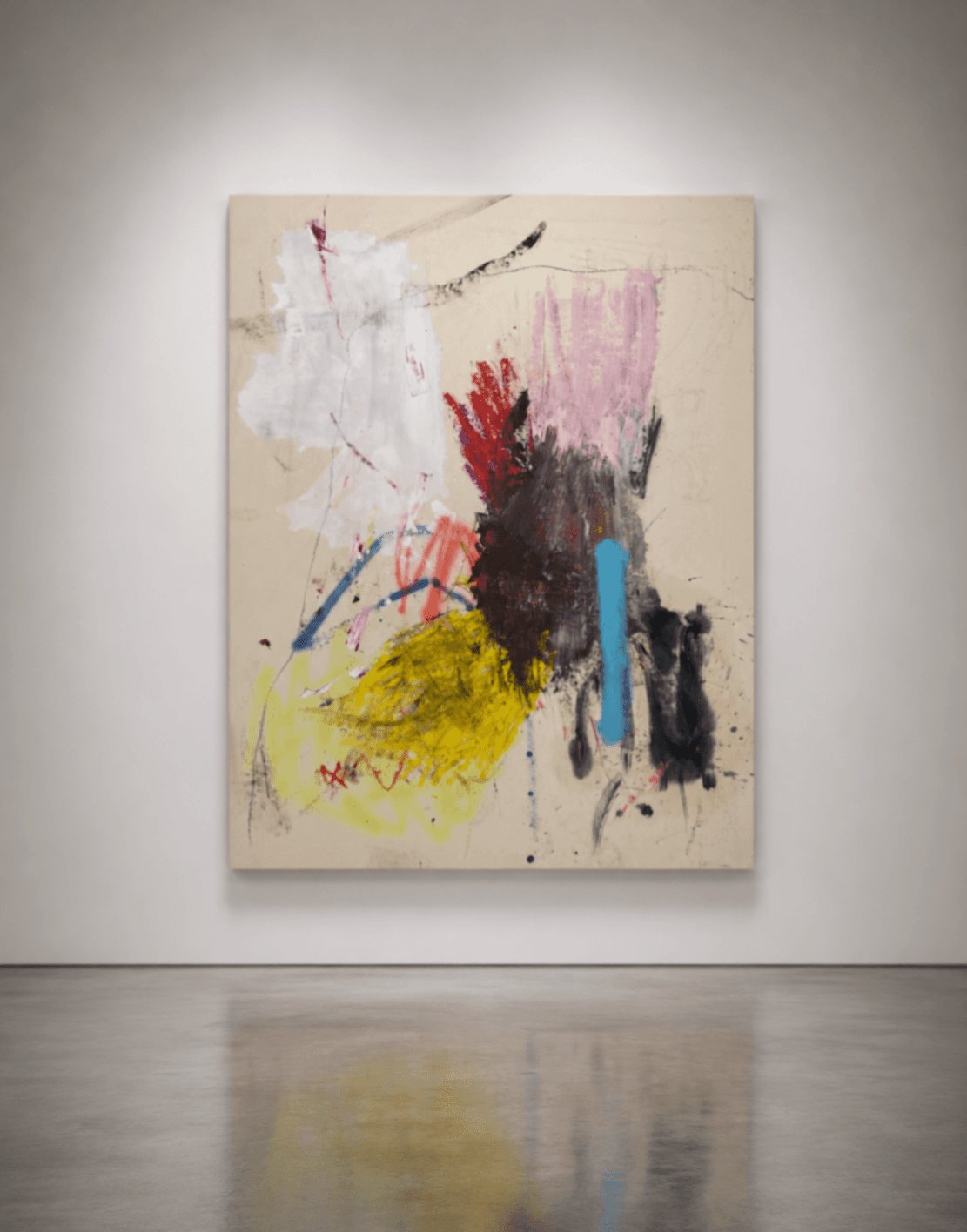
Nervous lines, repeated strokes, marks that resemble scratches, layers that cover other layers without fully erasing them — the painting is not a clean surface. It is memory. What we see is not only the final outcome. We witness the trajectory.
His early works move through a phase of accumulation, where gestures appear repeated, forceful, almost aggressive. But saturation is not obsession. It is a recognition of inability — an inability to stop, to decide which mark is the right one, which gesture deserves to remain. The canvas becomes dense because the search is unfolding in real time. The painting does not yet know what it wants to be. And that hesitation is precisely what makes these works feel alive. The signs never settle into stable form. They remain active, vibrating, unfinished — always in the process of becoming.
From Saturation to Precision: The Evolution of a Pictorial Language
Then something begins to change. Not a rupture — a reorientation. Dervillez's abstract painting shifts toward clarity, breath, a kind of minimalism that is not decorative but exacting. Because writing is not simply adding more. To write is also to choose.
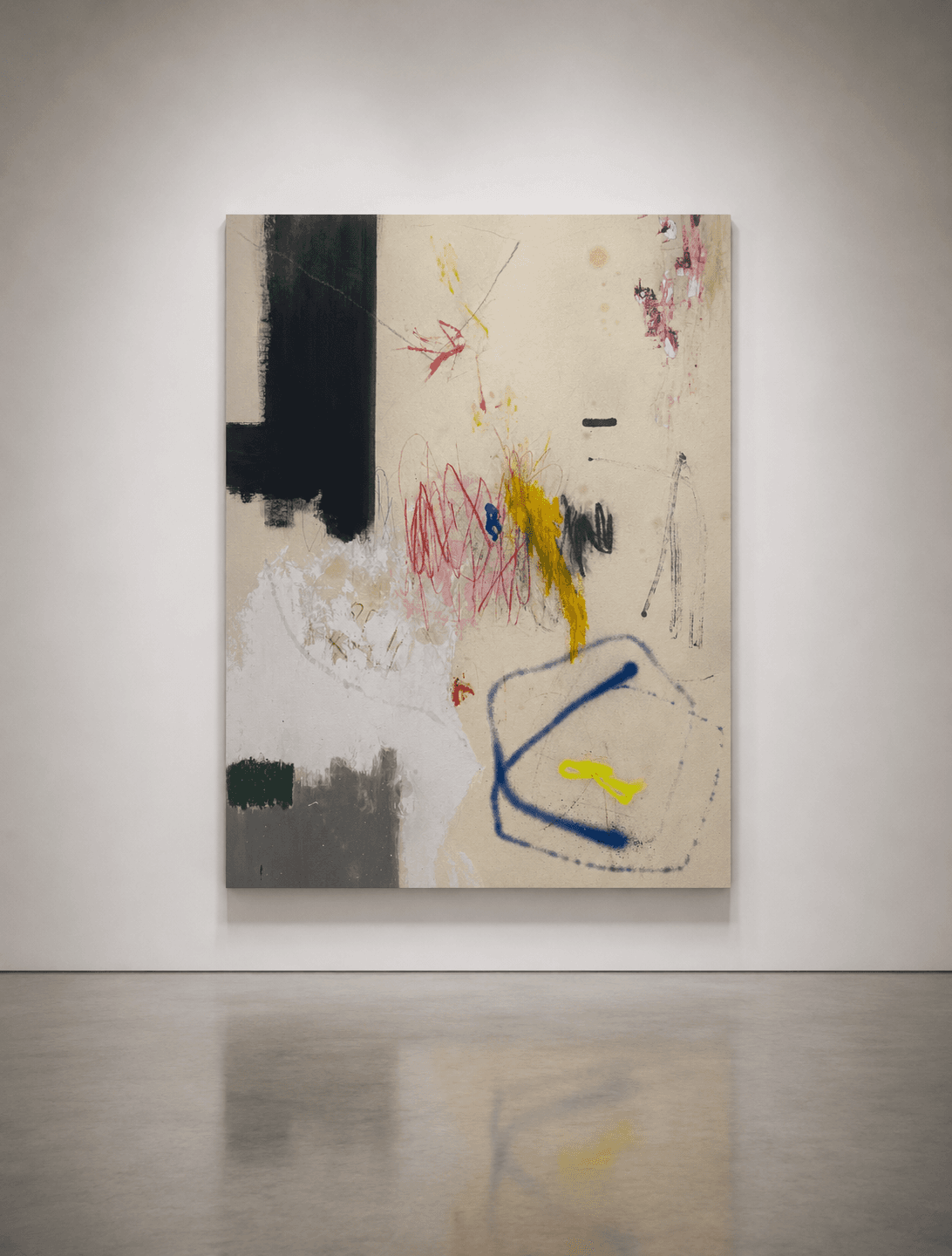
The canvas transforms into a space of decision-making. What is necessary? What can disappear? What must remain? In this new economy of marks, emptiness becomes as important as gesture. The white spaces are no longer unpainted areas — they are silences, deliberately constructed. And painting begins to function like a personal language: a form of calligraphy without a fixed alphabet.
“"The figurative confined me"
A sentence that unlocks much of his trajectory. Rejecting figuration was not rejecting reality. It was rejecting the obligation to deliver an immediately readable object. Figurative painting assigns meaning too fast, closes interpretation before it can begin. He sought an open painting: one that remains readable as gesture before it becomes readable as motif. He does not paint an object. He paints a dynamic — the movement of a hand deciding, the residue of a thought caught mid-flight.
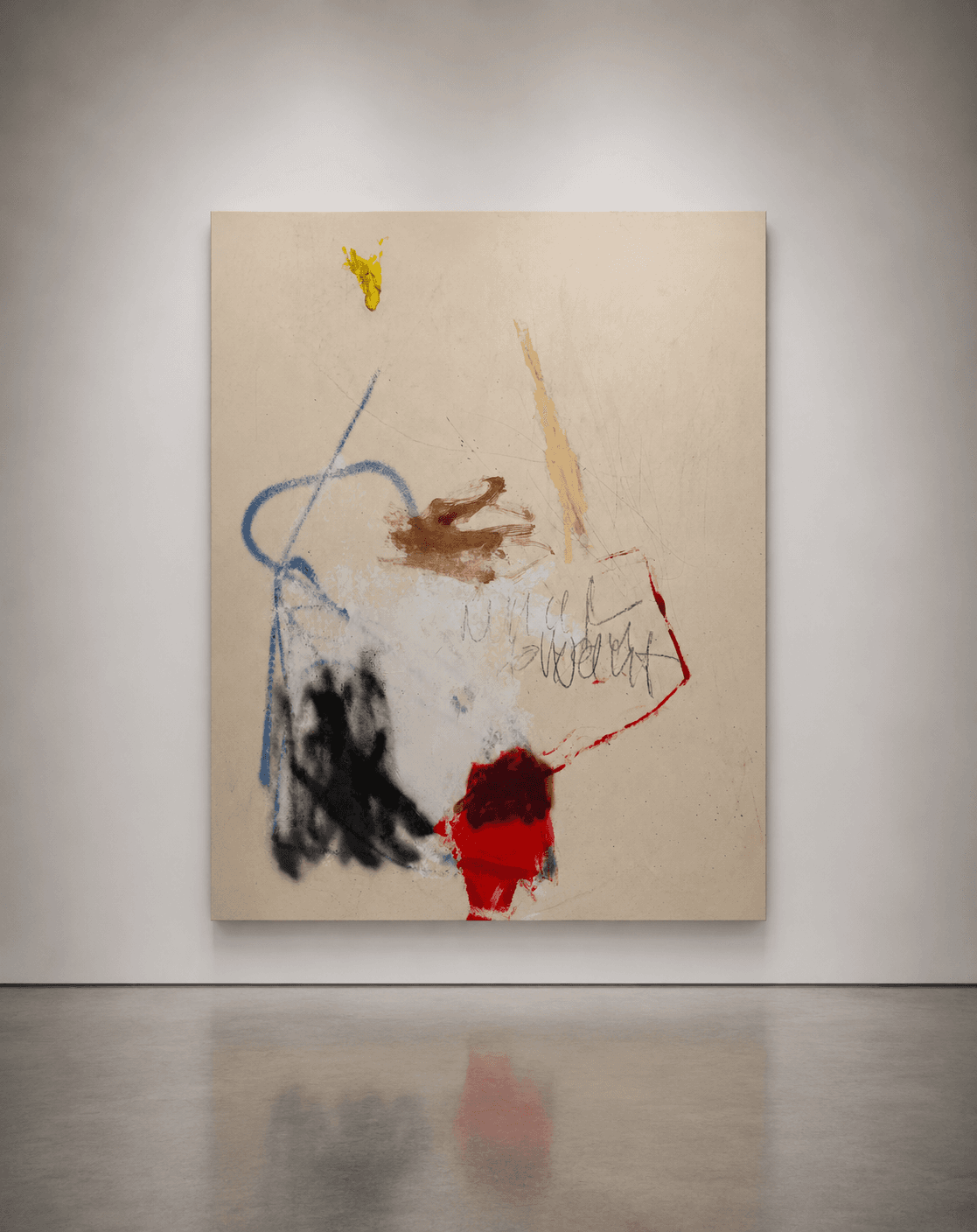
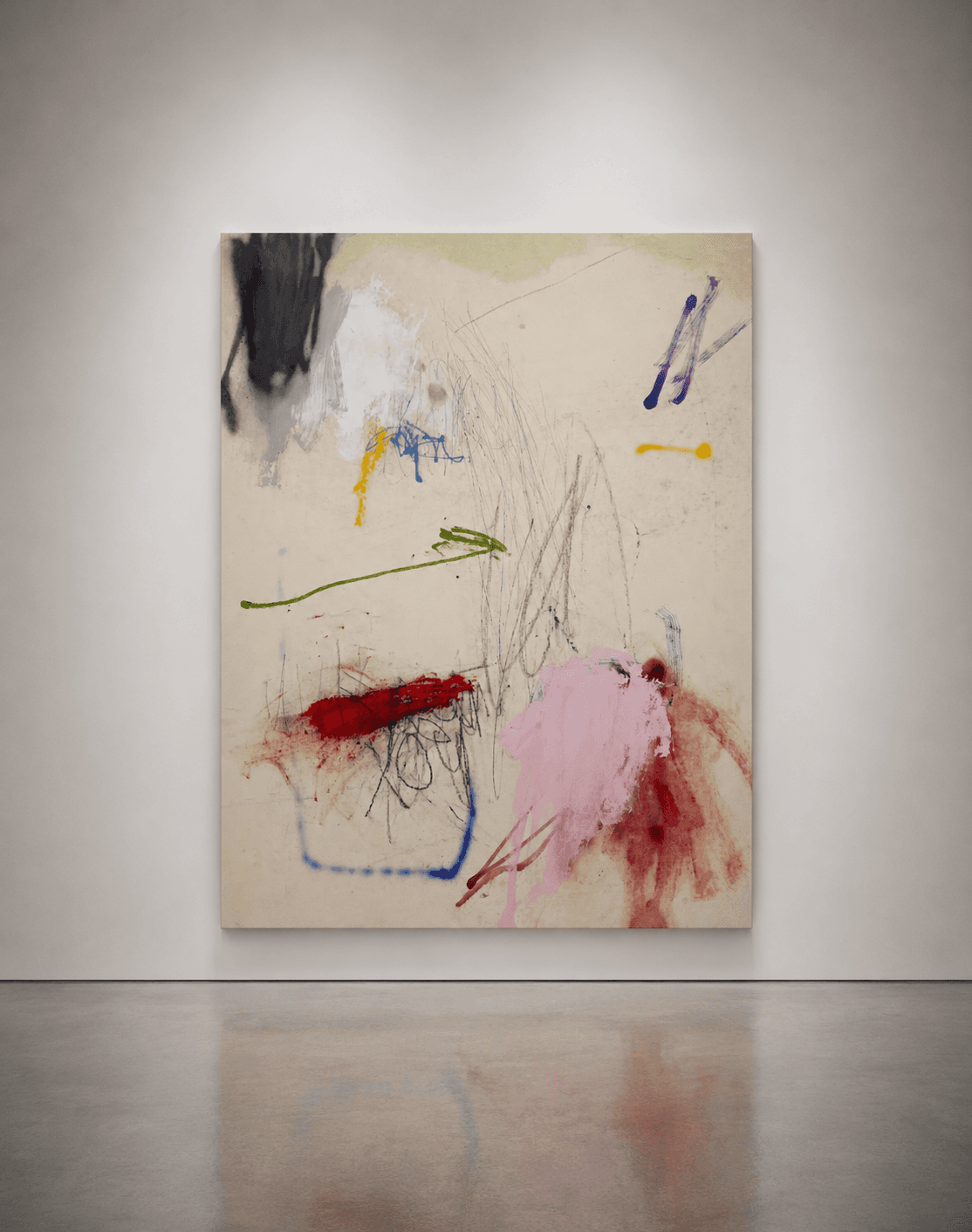
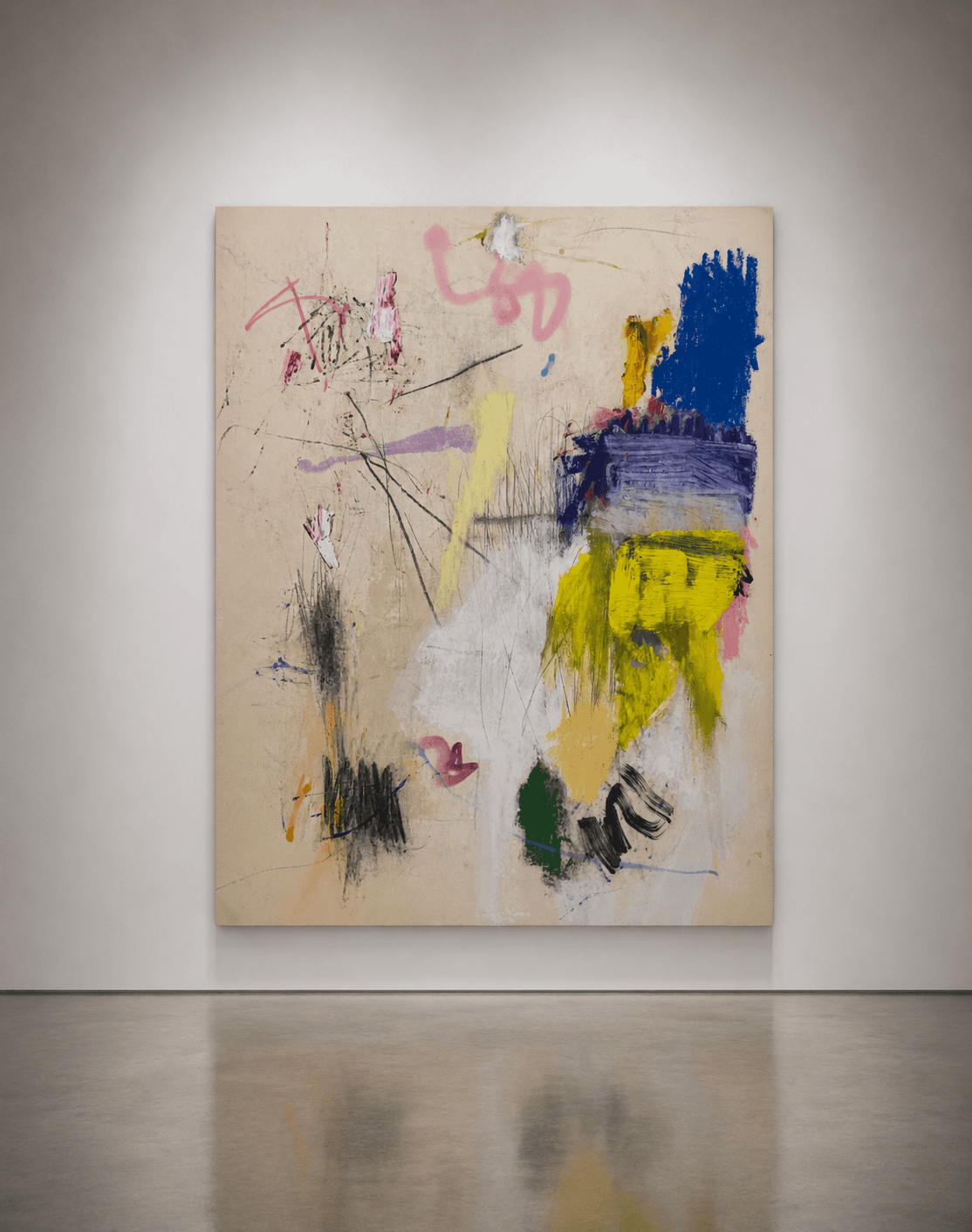
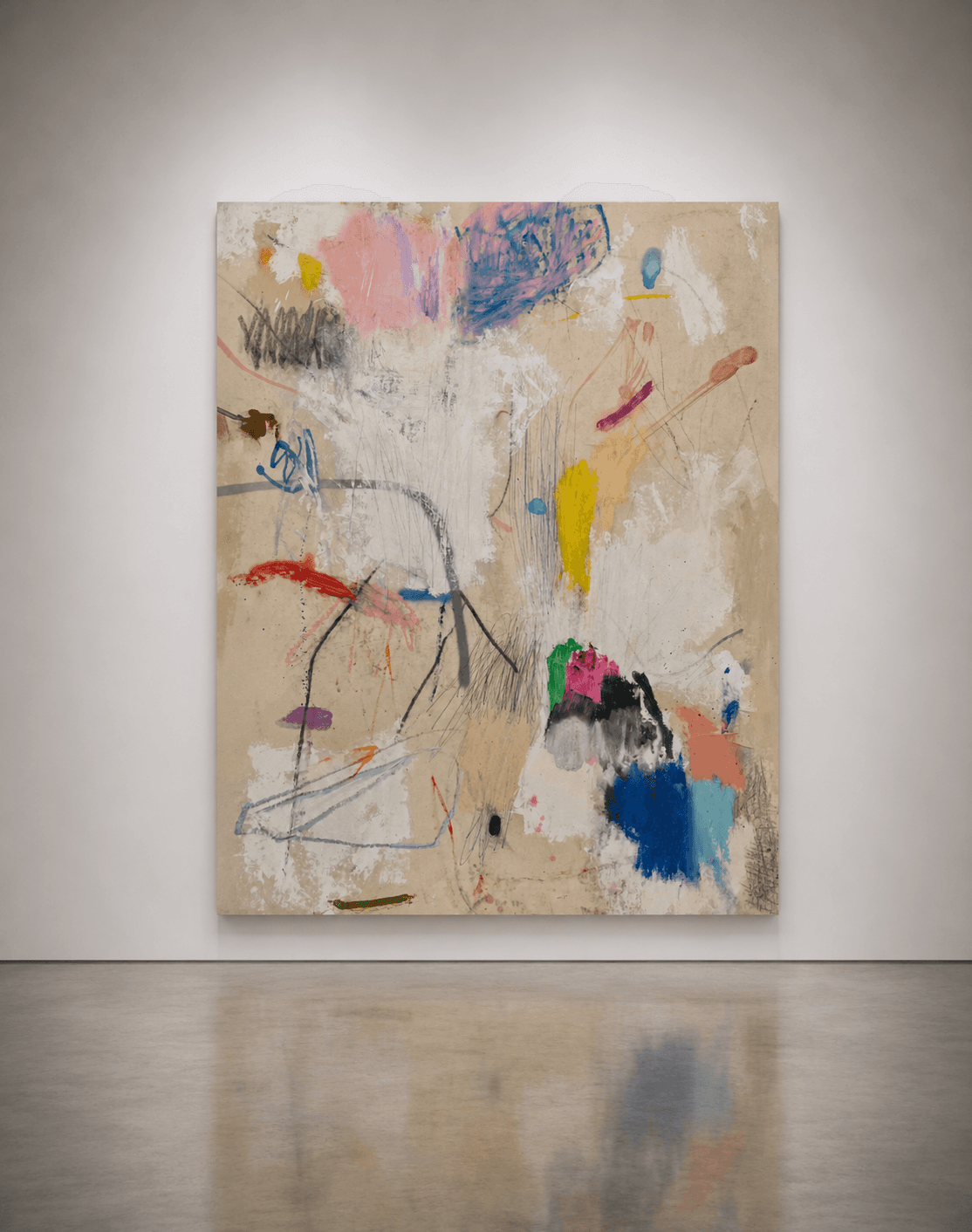
The recent UNTITLED series — works numbered 151 through 164 — represents Dervillez at his most refined. The surfaces are spare, the gestures reduced to their minimum effective dose. A single dark arc against a warm grey ground carries the weight of an entire composition. Each work shares the same dimensions (116 × 89 cm), creating a cohesive body of work — variations on a theme, each one a singular resolution of the same core question: what is the minimum gesture needed to make a painting feel complete?

What Remains
Look at UNTITLED 163 long enough and something curious happens. The dark arc that first appears as a single decisive stroke reveals itself as something more complex: layers of application, partial erasure, the ghost of a previous mark beneath. The painting has not been made. It has been arrived at.
The same is true of UNTITLED 160, where warm ochre and slate marks sit against a pale ground, the composition so pared down that every element carries disproportionate weight. A slight shift in the angle of a line would change everything. The tension is palpable. You find yourself holding your breath, as if the painting might change if you look away too long.
This is what makes Dervillez's work magnetic — not what it shows, but what it almost shows. The gesture that nearly happened. The mark that was almost left. The painting as a record of decisions made and unmade, visible in the same breath.
He exhibits regularly in France and internationally, building a quiet but growing reputation among collectors drawn to abstraction that rewards sustained attention. The work does not explain itself. It waits.
The real question his paintings pose is not: what does this represent? But rather: what does it awaken in me? Perhaps that is the true power of this work — it reminds us that a painting can be a space of reading. Not reading an image, but reading a living movement.
Across the UNTITLED series, each work speaks to the others. UNTITLED 164, with its darker ground and more insistent mark, feels like a counterpoint to the restraint of UNTITLED 163. UNTITLED 157, more open and breathable, lets the ground do most of the work. Together, they form a conversation — six variations on a single question, each answer slightly different, none definitive. It is this coherence without repetition that marks Dervillez as an artist worth following.
He works in mixed media on canvas, combining materials that allow for both swift gesture and slow construction. For collectors interested in the mechanics of value, our guide to limited editions and authentication offers a useful framework. The choice is deliberate: mixed media lets him build, erase, and build again in ways that paint alone would not permit. The surface becomes a record of its own making.
FAQs
Who is Ludovic Dervillez?+
What is his artistic style?+
What influences his work?+
Where to view and purchase his works?+
Related artist
Ludovic Dervillez→Related works