Focus
Farrah Lee — Emotion as Material: Painting as an Act of Presence
Farrah Lee turns raw canvas into a record of gesture — a Canadian abstract expressionist whose paintings hold restraint and release within a single surface.

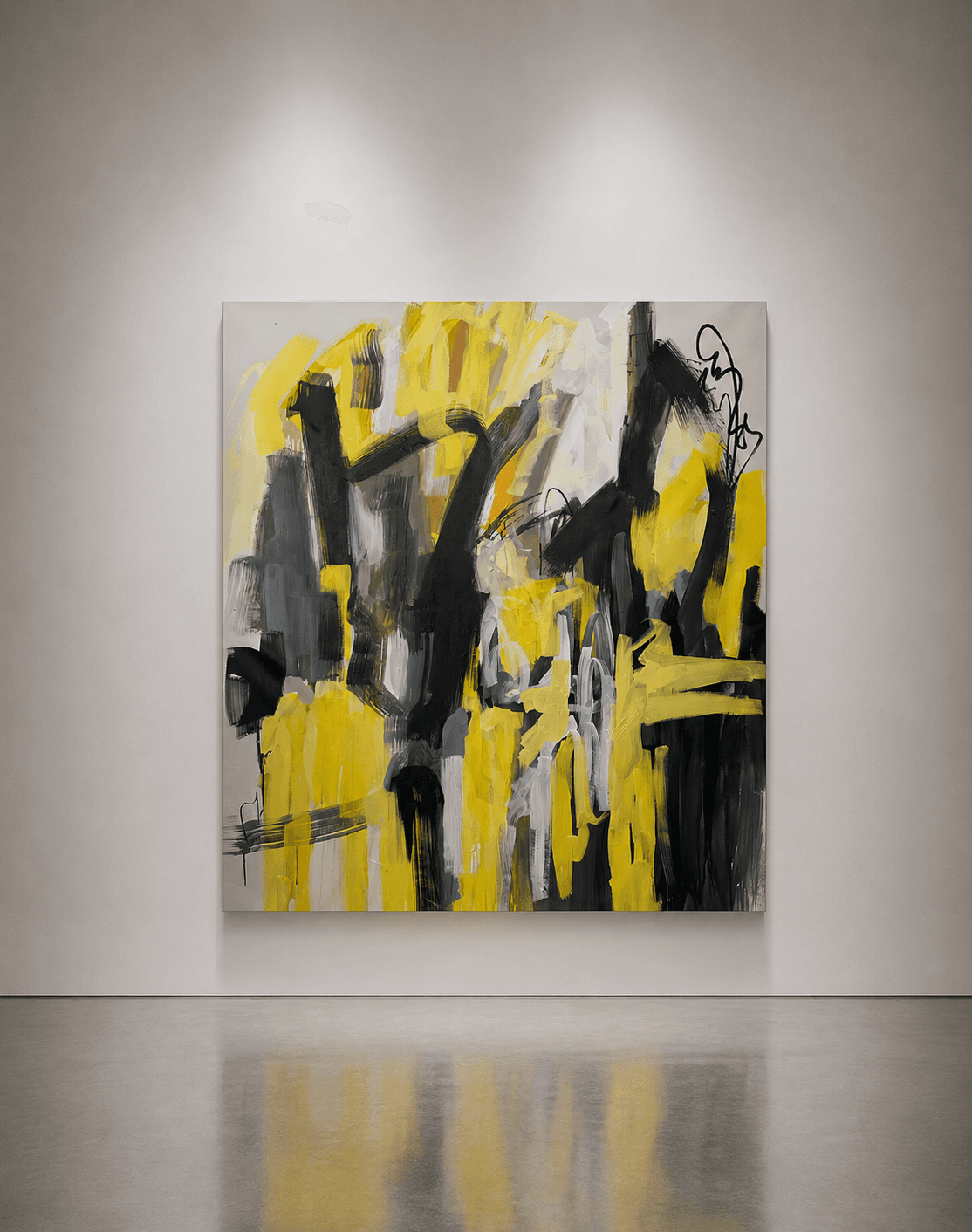
A visitor stops mid-stride in front of DANDELION. The yellow reaches her first — flat, unapologetic, almost loud. Then the black: thick angular strokes that cut through the colour like branches caught in wind, and one looping line, upper right, that curls back on itself like a signature no one asked for.
She steps closer. The brushwork is not tidy. A stroke thins where the arm slowed, thickens where it didn't. Paint sits in ridges where the brush was loaded, then drags to nothing where it wasn't. Nothing here was corrected.
She steps back again, and the question that stays with her is not what does this mean. It is simpler, and harder to answer: what did it take to make this mark, and why does it still feel urgent?
That question is the entry point into the work of Farrah Lee, a Canadian abstract expressionist based between Montreal and an international collector base. Her paintings do not illustrate emotion. They register it, stroke by stroke, at the scale of the body.
There is no myth of the untrained hand here. Lee spent years directing an art school before she returned to her own canvases, and that history sits inside every mark — instinct that has been tested, corrected, and tested again until it no longer needs correcting. The visitor in front of DANDELION does not know this yet. She only knows that the painting is not asking to be decoded. It is asking to be met.
Farrah Lee: When the Canvas Becomes Body
Farrah Lee paints in acrylic, often on raw, unprimed canvas. The choice is not incidental. Raw canvas absorbs. It does not let paint sit politely on the surface — it pulls pigment into the weave, records bleed and drip as permanently as it records a deliberate stroke. Nothing is reversible. Every mark stays exactly where the arm put it.
This is gestural painting in its most direct sense: the canvas as a surface that receives the body's movement without translation. Speed shows. Hesitation shows. Confidence shows. There is no narrative standing between the viewer and the physical act that produced the work.
This is also what separates Lee's practice from illustration, however abstract. A figurative painter can revise a mouth until the expression reads as intended. Lee cannot revise a gesture without the revision becoming visible history, layered into the next one. Every canvas carries its own edits in plain sight — which is precisely what gives the work its charge. The viewer is not looking at a finished statement. They are looking at a decision, and the decisions that came before it.
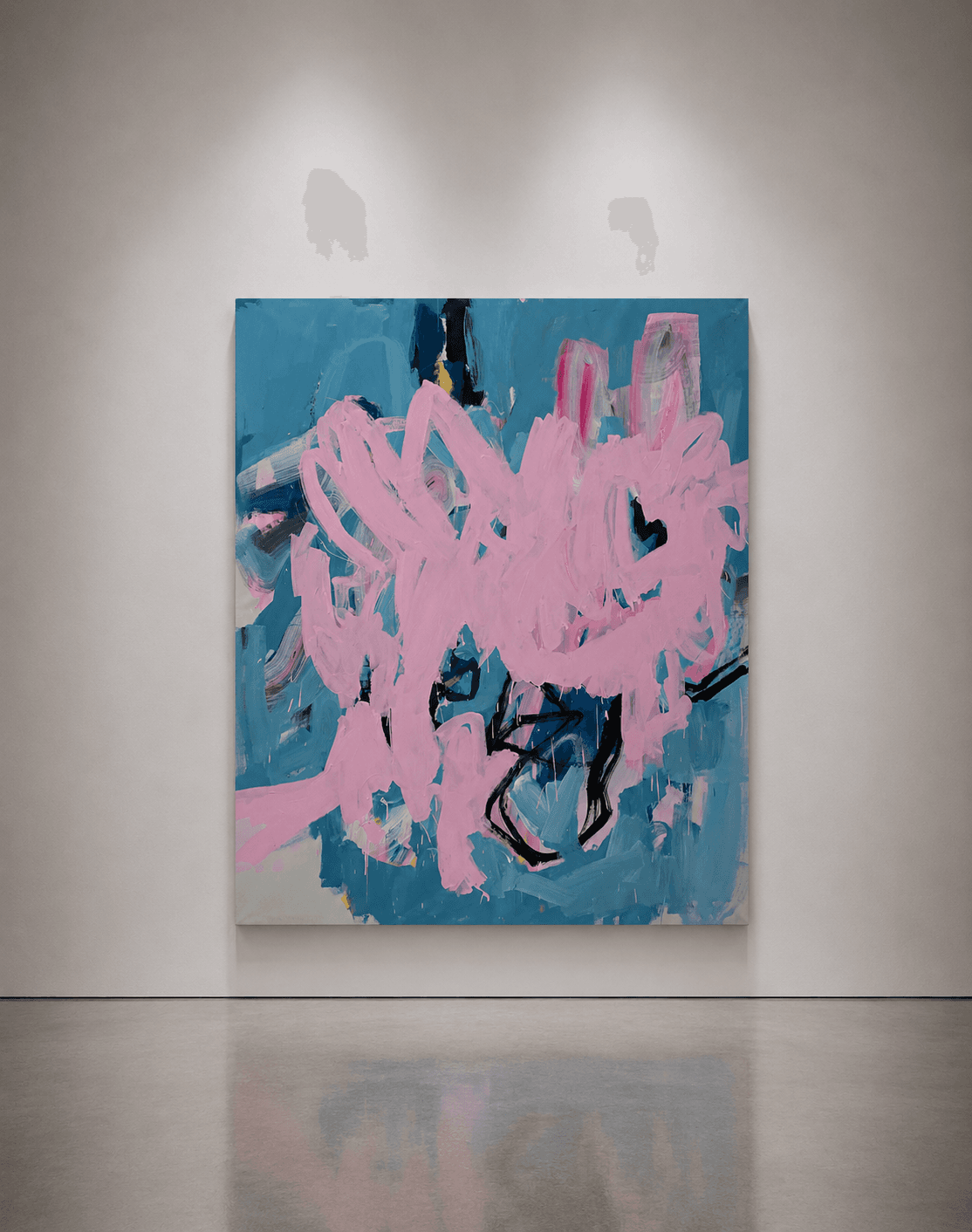
FLUSTERED BLUSH makes this vocabulary explicit. Loops of bubblegum pink move across a petrol-blue ground in a single, sustained gesture — thick, looping, almost like handwriting scaled up until it stops being legible and becomes pure motion. Underneath, a black linear structure shows through, wiry and caged, as if an earlier, more contained mark had to be broken open before the pink could happen.

The title names an involuntary reaction — a blush is not chosen, it happens to you. The painting works the same way. The pink loops read as something that escaped rather than something composed, a gesture too fast to edit.
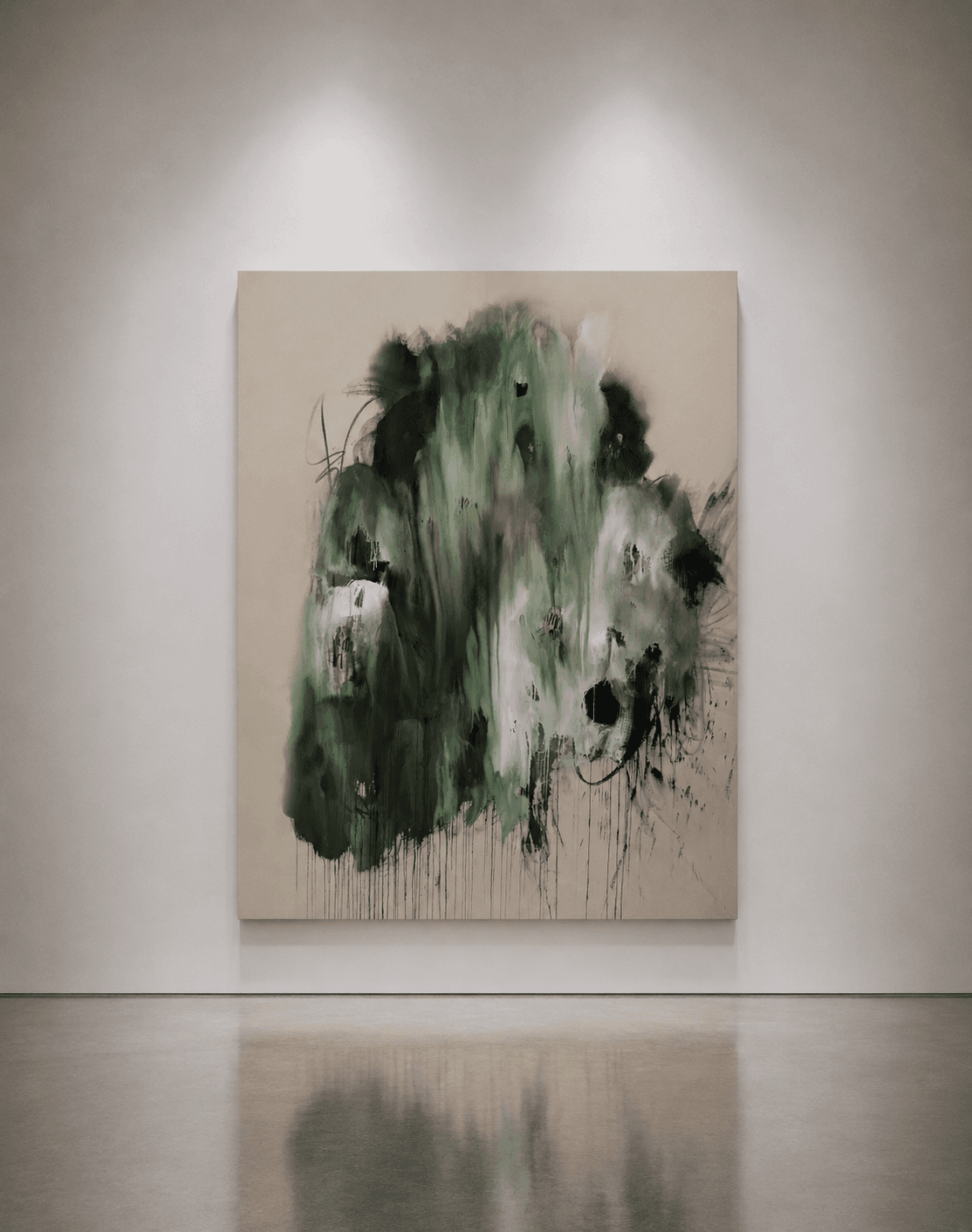
COPIOUS ESCAPE takes the same physicality and slows it down. A dense mass of moss green, sage, and charcoal sits mid-canvas, built from layered washes rather than a single pass. Vertical drips fall from its base into the exposed, undyed canvas below, like rain the painting could not hold onto.

At 223 centimetres tall, the canvas exceeds the body that made it. Fine, scratched lines radiate outward from the mass — grass, wire, static, take your pick. They read as residue: what escapes a form when it is layered past the point of containment. Where FLUSTERED BLUSH is a single fast gesture, COPIOUS ESCAPE is accumulation — proof that Lee's physicality works at more than one speed.
Set beside each other, the two paintings argue for the same premise from different directions. FLUSTERED BLUSH proves that a single gesture, unedited, can carry an entire emotional charge. COPIOUS ESCAPE proves that many gestures, stacked patiently over time, can arrive at something just as physical, just as immediate. Fast or slow, the canvas in Lee's hands never stops behaving like a body — receiving pressure, absorbing colour, holding the record of its own making.
Farrah Lee: From Teaching to Painting
Farrah Lee did not arrive at her own studio practice directly. At 25, she was already running an art school — not studying under someone else's direction, but directing hundreds of students through their own. For years, her daily work was watching other hands find their gesture before she returned, fully, to her own.
That sequence matters. Teaching mark-making means breaking it down constantly: why does a stroke read as tentative, what makes a gesture look earned rather than decorative, how does pressure change meaning. Explaining these things to hundreds of students, over and over, is a form of discipline most painters never impose on themselves.
When Lee eventually stepped back from the school to focus on her own canvases, she carried that analytical eye into work built on instinct. Her paintings look spontaneous. The hand behind them had already spent years diagnosing spontaneity in other people's work — which makes her own harder-won.
"I find myself most free when working on large scales that allows my art to evolve and move with my inspiration," Lee writes in her artist statement. "I am a true intuitive painter."
There is a common assumption that teaching drains a practice, that the hours spent guiding other hands are hours stolen from one's own studio. Lee's paintings argue otherwise. The precision visible in a work like FLUSTERED BLUSH — a single gesture that reads as both loose and structural — is not naive confidence. It is the result of having watched hundreds of gestures fail, succeed, and fail again, at close range, for years.
This is also a distinctly Canadian story of practice, if not subject matter: an artist who built infrastructure — a school, a community of hundreds of students — before claiming space for her own work within contemporary Canadian abstraction. Many gestural painters arrive at the studio first and teach later, if at all. Lee's path ran the other way, and the sequencing shows in the authority of her mark-making.
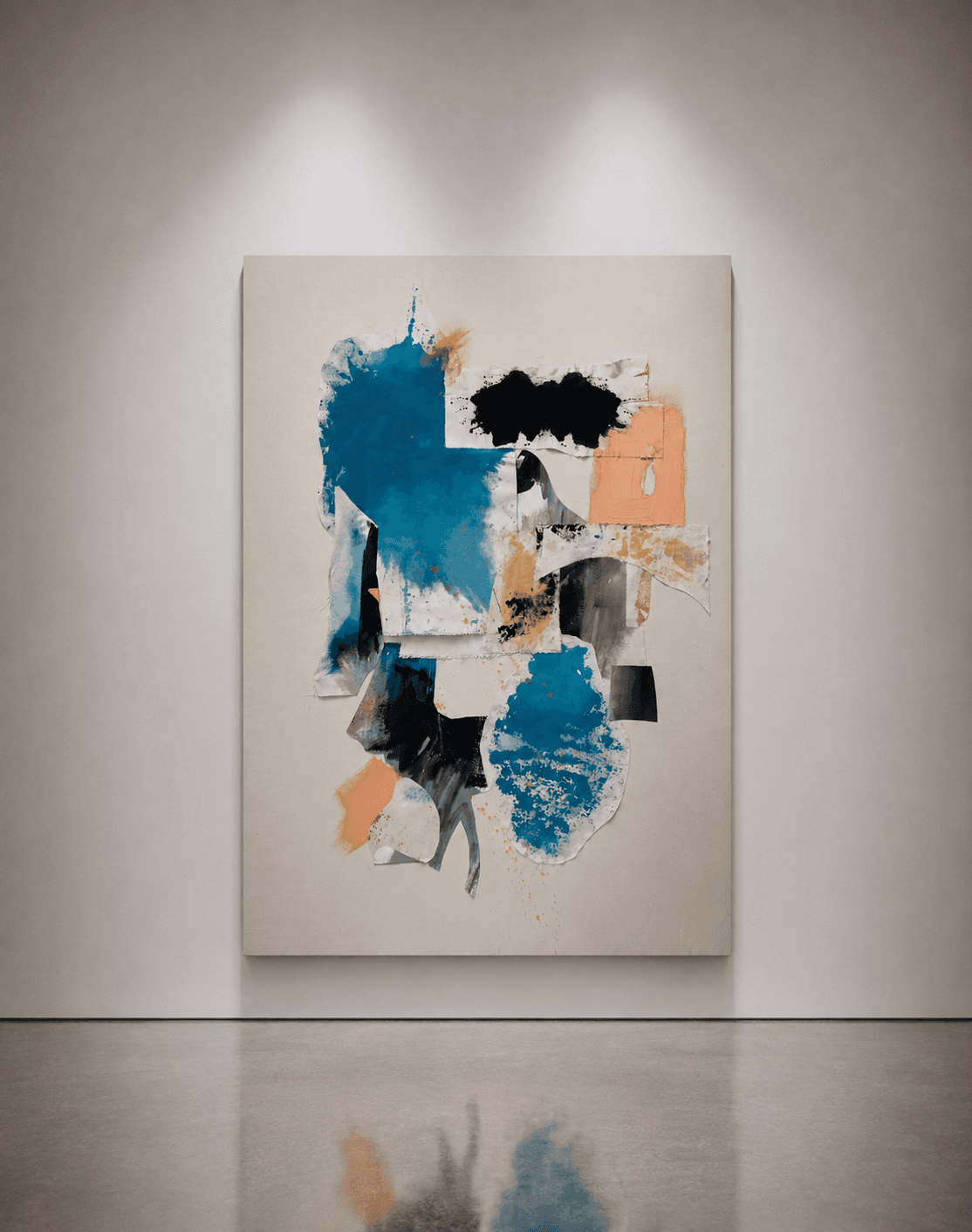
FLY THE COOP carries that transition almost too neatly in its title, though the painting earns the reading on its own terms. It departs from pure gesture into mixed media: torn and collaged fabric panels in cerulean blue, black, and peach, patched together rather than painted in a single continuous field.

The composition reads as fragments finding a new arrangement — pieces of fabric, paint, and paper that no longer belong to a single, unified ground. A cloud of black sits upper centre, dense and unresolved, while a splatter of gold drips down through the seams between panels. It is the closest thing in Lee's catalogue to a painting about departure: material pulled apart and reassembled on new terms, the way a practice does when it leaves an institution behind.
Nothing in FLY THE COOP is smoothed over. The seams between panels stay visible, the torn edges stay torn. That refusal to disguise the construction is consistent with everything else in Lee's practice: process stays legible, whether it is a single loaded brushstroke or a canvas built from stitched fragments. The work does not pretend the transition from teaching to painting was seamless. It shows the seams, and lets them hold the composition together anyway.
Emotion Held, Emotion Released
Two canvases in Lee's current body of work make an unmistakable pair — not because they share a palette, but because they sit at opposite ends of the same emotional register.
This pairing places Lee within a lineage of gestural painting that runs back through post-war Abstract Expressionism, where the canvas was treated as an arena for the body rather than a surface for illustration. But Lee's contribution to that inheritance is specific: she does not treat restraint and release as a before-and-after. She treats them as two separate, complete emotional states, each deserving its own canvas.
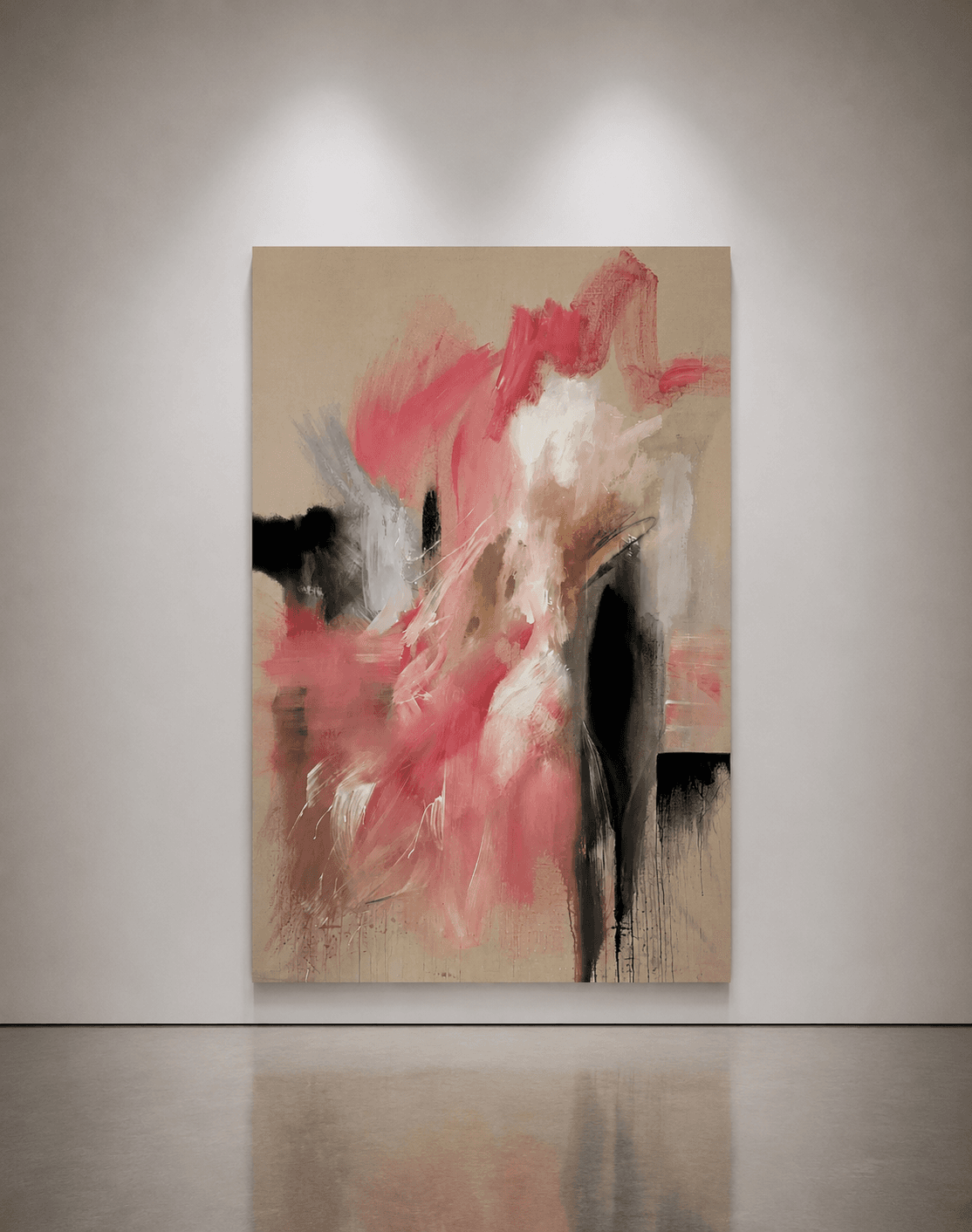
AWAITING is vertical restraint. A plume of coral and salmon rises diagonally from lower left to upper right, blended wet into cream, white, and ochre rather than laid down flat. A solid black form stands to the right like a column, thin drips falling from its base. The gesture climbs. It does not detonate.

Even at its most saturated, the colour in AWAITING stays contained inside a rising column. The raw canvas around it stays untouched, wide, patient. The title is exact: this is a painting about the moment before something happens, not the event itself.
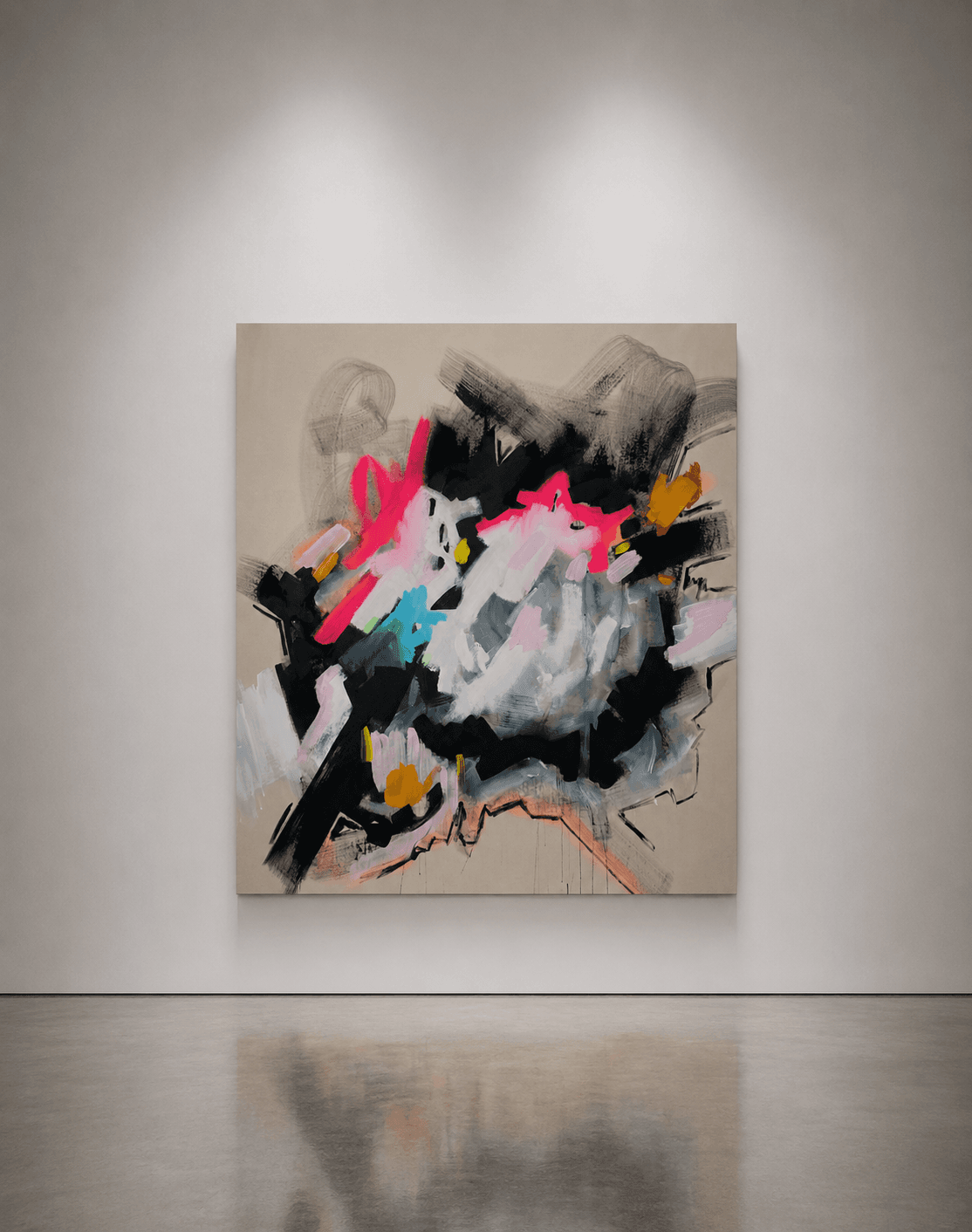
IGNITE is the opposite decision. Where AWAITING rises, IGNITE clusters — a dense, near-circular knot of fuchsia pink, charcoal-black strokes, and white impasto, hit with small flares of cyan and mustard yellow. The mass sits compact at the centre of the canvas, radiating rather than climbing, hot rather than held.

Placed side by side, the two works describe the full range Lee works within. AWAITING holds. IGNITE releases. Neither is more resolved than the other — restraint and eruption are treated as equally valid emotional states, not as a build-up and payoff. That refusal to rank feeling is one of the more sophisticated aspects of her practice.
The formal parallels between the two canvases sharpen the contrast rather than soften it. Both are built in acrylic. Both are close in scale — AWAITING slightly taller, IGNITE slightly wider, near-square. Both use black as an anchoring structural element rather than a shadow. What differs entirely is direction: one climbs, one clusters. Lee is not repeating a formula with a different palette. She is showing that the same technical vocabulary can hold two opposite emotional truths without contradiction.
Why Collectors Are Watching Farrah Lee
As a contemporary Canadian artist, Farrah Lee's trajectory reads as unusually coherent for someone still expanding her market presence. She did not arrive at painting as a first career, and she did not arrive at it casually. Running an art school for years, before returning fully to her own canvases, gives her current output a technical grounding that shows in the confidence of every gesture.
That confidence is visible across mediums. A collector who places FLUSTERED BLUSH next to FLY THE COOP is not seeing an artist repeating a formula. They are seeing a practice that moves comfortably between pure gestural acrylic and mixed-media construction, without losing the physical directness that defines her hand.
Rarity matters here too. Lee's canvases are built slowly, in layers, and her output does not follow a production schedule designed to flood a market. Works like COPIOUS ESCAPE, at over two metres tall, represent a significant physical and material commitment per canvas — a signal, for collectors, of scarcity rather than volume.
Her collector base is already international, a market signal that typically follows sustained institutional or peer recognition rather than a single viral moment. For collectors building a considered collection, Lee's work rewards looking at scale and material together: raw canvas versus primed canvas, acrylic alone versus mixed media, vertical restraint versus radiating cluster. Each choice marks a different register within a single, legible practice.
There is also a practical case for acquiring early in a coherent trajectory like this one. Artists who move fluently between mediums — pure gesture in FLUSTERED BLUSH, mixed media construction in FLY THE COOP, monumental scale in COPIOUS ESCAPE — tend to be harder to pin to a single signature look. That range can slow initial market recognition, but it also means a collection built now, across formats, will read as unusually complete once the range itself becomes the story critics tell about her.
For a first acquisition, look for the pairing logic that runs through the practice rather than a single "best" canvas. A collector who owns one contained, vertical work and one radiating, clustered work — AWAITING and IGNITE, for instance — holds the emotional range of the practice in miniature, not just a single mood caught once.
FAQs
Who is Farrah Lee?+
What is Farrah Lee's artistic style?+
What influences her work?+
Where can I view and purchase Farrah Lee's works?+
Conclusion
The visitor returns to DANDELION before she leaves the gallery. The yellow still reaches her first. But now she sees the black strokes differently — not chaos cutting through colour, but a structure the colour had to survive.
She never gets a tidy answer to her question. What did it take to make this mark, and why does it still feel urgent? Farrah Lee's paintings do not resolve that question. They hold it, the way AWAITING holds a rising plume of colour, the way IGNITE holds a knot of pink and black that has not yet come apart.
That refusal to resolve is the point. Lee's canvases ask for presence, not explanation — a viewer willing to stand still long enough to feel what a gesture, built at the scale of the body, still carries.
Farrah Lee's work can be viewed at AH Milans Gallery, and our behind the scenes article explains how we select artists like her for the roster, and followed at @farrahleeart and farrahleeart.com.
For a broader introduction to the field, see our guide to What Is Contemporary Abstract Art?
Related artist
Farrah Lee→